
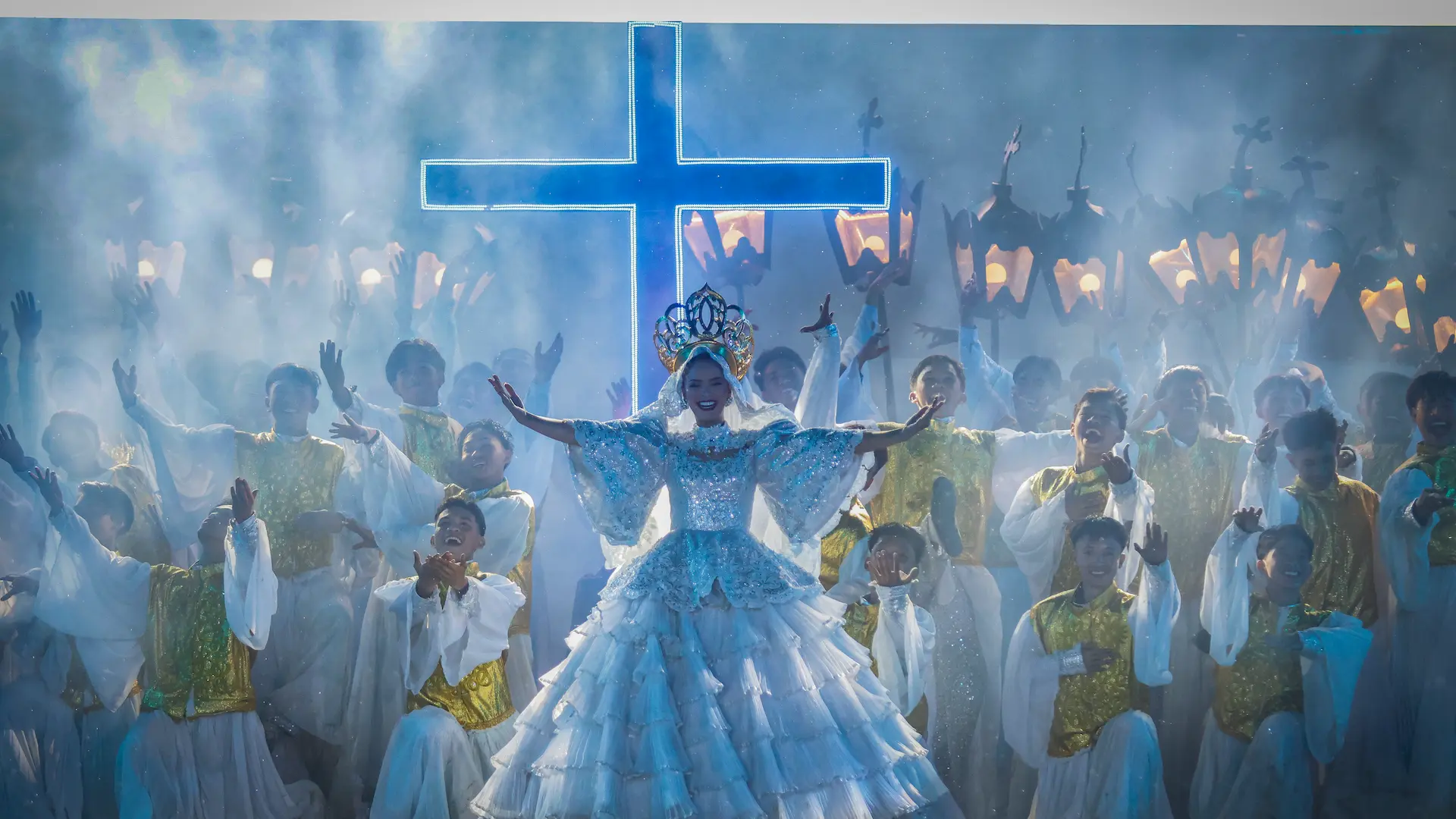
Is Pasigarbo sa Sugbo Still Worth Reviving in 2026?
Pasigarbo sa Sugbo is returning in 2026—but under a different name, a smaller field of participants, and a new set of rules intended to prevent the festival from becoming another costly overnight spectacle.
The idea of reviving Cebu’s “Festival of Festivals” initially gained traction online after a June 1 social media post suggested renaming the event as Pasundayag sa Sugbo for the upcoming Cebu Province Founding Anniversary.
Governor Pamela Baricuatro warmly embraced the concept, suggesting the showcase be limited to district winners to prevent the program from dragging into the early hours of the morning.
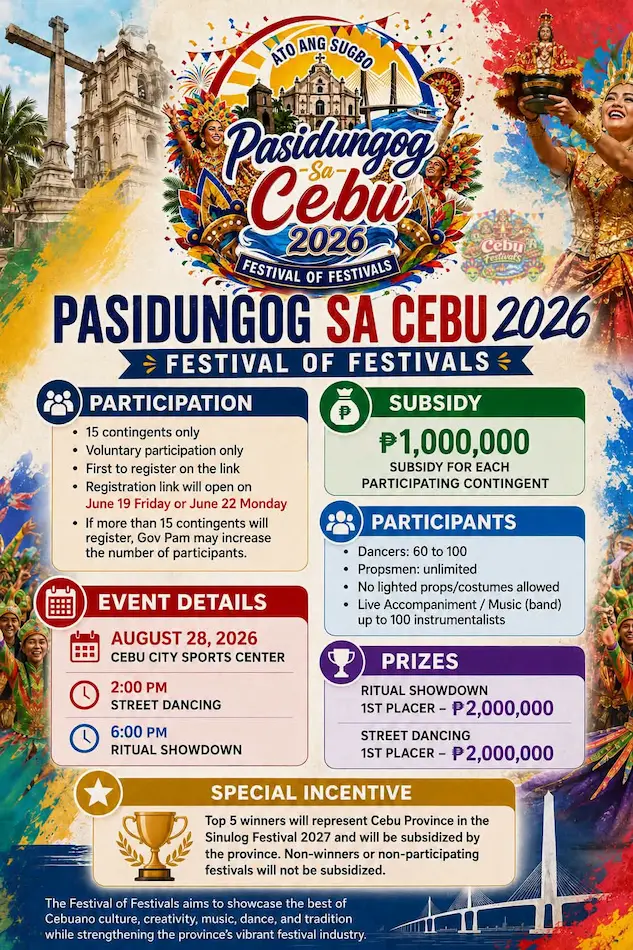
Since that initial exchange, the revival has moved rapidly from casual online suggestion to concrete policy. Event materials circulating among participating local governments now refer to the event as the Pasidungog sa Sugbo 2026, with the competition officially scheduled for August 28 at the Cebu City Sports Center.
The question is no longer whether the festival will return. The more important question is whether Cebuanos should welcome it back.
Quick Summary
- A Leaner Return: Rebranded as Pasidungog sa Sugbo, the 2026 revival introduces tight operational boundaries—capping performer numbers, mandating live music, and banning expensive light effects to reduce cost and avoid the exhausting long hours of the competition.
- The Fiscal Dilemma: While this new model promises a massive downsize from 2024’s staggering ₱255-million expenditure, the baseline budget remains to be multi-million-peso public investment. True cost-efficiency can only be declared once a full, all-inclusive budget is transparently made public.
- A Question of Priorities: The festival’s timing forces a hard look at provincial spending. Holding a large-scale celebration while storm and earthquake-hit communities are still recovering raises valid questions about its necessity.
- The Editorial Verdict: Preserving local culture and paying Cebuano creative workers is entirely worthwhile, but true tribute requires absolute financial transparency. Cebu needs a festival that honors its rich heritage, not its former extravagance.
What Is Changing in the 2026 Festival?
The proposed 2026 format is considerably leaner than the massive Pasigarbo sa Sugbo iterations of the past. Rather than gathering more than 50 contingents from nearly every corner of the province, Pasidungog will initially accommodate just 15, and participation will be entirely voluntary.
To keep the competition grounded and cost-effective, several strict guidelines have been introduced:
- Subsidies: Each participating contingent will receive a ₱1-million subsidy.
- Performer Limits: Dancers will be limited to between 60 and 100 per group.
- Aesthetic Restrictions: Costumes and props with light effects are no longer allowed.
- Live Music: Recorded festival jingles will be replaced by live musical accompaniment, allowing up to 100 instrumentalists per contingent.
- Prizes & Incentives: The grand champions of the street-dancing and ritual-showdown competitions will each receive ₱2 million. The top five contingents will earn the right to represent Cebu Province at Sinulog 2027 with financial backing from the Provincial Government.
On paper, these changes directly address long-standing complaints. Fewer contingents mean a shorter and time-efficient program. Voluntary participation relieves pressure on cash-strapped municipalities, while caps on dancers and a ban on illuminated tech effectively end the hyper-expensive arms race for the largest, brightest production.
Furthermore, requiring live music is a highly welcome shift. It restores raw energy to the performances and puts local Cebuano musicians back at the heart of cultural storytelling.
But a downsized festival on paper does not automatically guarantee inexpensive execution.
Smaller on Paper, But How Small in Practice?
A quick look at the math reveals a substantial baseline commitment. If 15 contingents receive a ₱1-million subsidy, and we factor in the ₱4 million combined grand prizes for street dancing and the ritual showdown, the public layout already sits at a minimum of ₱19 million.
This baseline does not yet account for:
- Prizes for runners-up and special categories
- Staging, venue preparation, sound systems, and lighting
- Logistics, security, medical teams, and traffic management
- Future subsidies promised to the top five contingents for Sinulog 2027
The dancer limit also warrants a closer look. While capped at 100 dancers and 100 musicians, the number of support and props personnel remains unlimited. A single delegation could easily exceed 200 people before factoring in choreographers, makeup artists, and drivers. While this represents vital seasonal employment for the creative sector, it proves that a smaller stage footprint doesn’t automatically mean a low-cost production.
Pasidungog can only be praised as genuinely cost-efficient once the Provincial Government releases a comprehensive, all-inclusive budget. A smaller festival is a promising start, but it shouldn’t be mistaken for fiscal responsibility until the final numbers are made public.
Is Pasigarbo Still Relevant?
Launched in 2008, Pasigarbo sa Sugbo was designed to give Cebu’s diverse towns a platform to showcase their unique local cultures, histories, and economic products. At its peak in 2024, it gathered 51 contingents and over 10,000 performers in a marathon showdown that lasted until 3:00 AM.
At its best, the festival was far more than a simple dance competition. It allowed a fishing community, a remote farming town, or a heritage district to stand before the entire province and say: This is who we are, this is what we build, and this is our story.
Beyond cultural pride, the festival serves as a vital economic engine for the creative sector. It injects seasonal income directly into the pockets of choreographers, costume designers, seamstresses, carpenters, prop makers, makeup artists, and local transport operators—workers whose labor is intensive but often undercompensated.
When the festival faced heavy criticism in 2024, 49 Cebu mayors signed a manifesto defending it, pointing to the undeniable boost it gave to local livelihoods and tourism.
This move solidified their stance that the creative sector should never be treated as purely optional or superficial. A public program that pays local artists and preserves living history is a completely legitimate use of government resources.
However, the issue was never a question of Pasigarbo’s relevance and importance. The problem was how staggeringly expensive that celebration became.
Why the Old Pasigarbo Became Hard to Defend
The 2024 edition of Pasigarbo sa Sugbo swallowed more than ₱200 million in subsidies and preparation costs, alongside roughly ₱55 million distributed in prizes. Governor Baricuatro later critiqued the previous administration’s format as a ₱255-million festival, arguing that Cebu could champion culture without sacrificing such massive sums on a single day.
Supporters frequently argue that this money isn’t lost; it circulates back into the local economy through small businesses and hospitality. While true, that economic activity alone doesn’t settle the debate. Public spending must always be weighed against the value it yields, whether the same results could be achieved at a lower price point, and whether more urgent public services are being neglected.
Furthermore, there are no independent, publicly available data measuring the long-term tourism income or sustainable jobs generated by past festivals. Without clear metrics, claims of absolute economic return remain purely anecdotal. A ₱255-million cultural program must be able to prove its value long after the stadium lights are turned off.
A Question of Priorities
Before taking office, Governor Baricuatro initially announced plans to discontinue both Pasigarbo and Suroy-Suroy Sugbo, citing the immense financial burden placed on smaller municipalities and the need to redirect funds toward essential services like healthcare.
It is worth noting that the current administration has followed through on its healthcare commitments. Under Cebu’s ₱11.9-billion budget, funding for 16 Capitol-run hospitals rose from ₱2.5 billion to ₱2.9 billion, while the Provincial Health Office budget climbed to ₱1.2 billion.
The revival of the festival does not mean healthcare has been abandoned. However, healthcare is not the only urgent crisis competing for public funds.
Moreover, the timing of Pasidungog cannot be separated from the disasters that shook Cebu last year—the magnitude-6.9 earthquake and Typhoon Tino. Affected communities are still actively rebuilding homes, classrooms, and infrastructure. The Regional Development Council is currently seeking over ₱6.6 billion in national rehabilitation funding, with billions in proposed projects still waiting on fund releases.
|
Project Category |
Requested Amount |
|---|---|
|
Roads, Bridges, & School Repairs |
₱4.5 billion |
|
General Disaster Rehab Program |
₱2.9 billion |
|
Temporary Shelters & Government Buildings |
₱105.6 million |
While government budgets are compartmentalized and funds cannot always be freely transferred from cultural pots to infrastructure, budgets still act as a declaration of priorities. Families still waiting for safe housing or repaired classrooms have every right to look at a stadium festival and question the urgency of the celebration.
Cultural events can undeniably heal and restore community confidence after a tragedy, but the festival must be handled delicately so as not to project an image of premature celebration while citizens are still struggling.
The Verdict: Culture, Not Extravagance
Public sentiment in Cebu isn’t rigidly split between those who love culture and those who hate it.
The warm reception to the scaled-down Pasidungog sa Sugbo format suggests a healthy middle ground: Cebuanos generally support the spirit of the festival, but they reject its former extravagance. They want to celebrate their heritage without the burden of excessive, out-of-touch multi-million-peso productions.
The new regulations for 2026 are highly encouraging, but they must be matched by radical financial transparency. To protect Pasidungog from the reputational damage that plagued its predecessor, the Provincial Government should publish a full financial plan ahead of the August 28 event, followed by a transparent post-event accounting of actual expenditures and measurable economic yields.
Is the festival worth reviving? Yes—but only if Cebu chooses to embrace its cultural essence rather than indulging in unwarranted spending.
Cebu does not need a ₱255-million spectacle to prove its greatness. It needs a festival where artistic ingenuity shines brighter than a wealthy city’s budget, and where the celebration onstage genuinely respects the taxpayers, the artists, and the disaster survivors funding it from the stands.
Featured Image Credit: Sugat-Kabanhawan Festival by Herbertkikoy / CC BY-SA 4.0